


First Responder Assistance K9 Program
Crisis-Responsive Canine Support Built on Precision, Presence, and Trust.


At Black Pirate Pup Co., our First Responder Assistance K9 Program trains a unique hybrid of service dog and therapy canine designed to live 24/7 within first responder institutions — such as fire stations and emergency response units — to deliver both emotional support and functional assistance to those who serve our communities. These dogs are trained not just to work — but to be present, grounded, accessible, and safe in high-stress environments.
Our philosophy integrates the foundational principles of the Quiet Precision Method™ with a focus on Animal-Assisted Intervention (AAI) and Animal-Assisted Crisis Response (AACR) so that each canine is uniquely prepared to support first responders during and after crisis events.
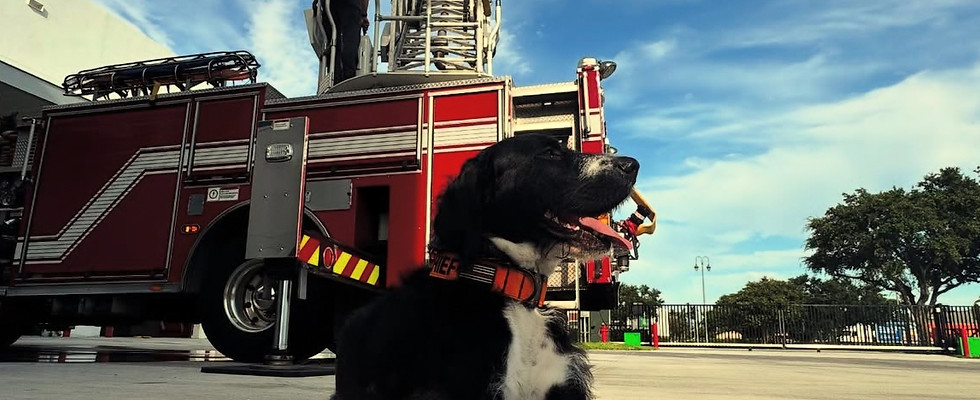
An assistance canine for your Fire Department will be part of the Critical Incident
Stress Management program for our first responders. This canine can operate both as a therapy
and a multi-purpose service dog that will be specifically task trained to assist our firefighters
after a difficult call. According to the International Association of Canine Professionals (IACP),
a therapy animal, in definition, is an animal that provides comfort in times of a crisis that results
in mass loss and/ or stress on an individual. Whereas a service animal, in definition, is
specifically task trained to aid an individual with disabilities. Although our first responders do
not have disabilities; extreme stress, anxiety or distress can have similar side effects as those
with legitimate mental disabilities. Thus, this canine will be specifically task trained for these
types of interactions and provide Animal Assisted Intervention (AAI) and Animal Assisted Crisis
Response (AACR).
AACR is a form of animal-assisted activity (AAA) that provides physical assistance and comfort to those who have been affected by natural, human-caused, or technological disasters and crises.
AACR is effective because the safety, familiarity, novelty, and interest in the animal have been found to be impactful when building rapport with a person affected by crisis or difficult situation, such as our firefighters experience on challenging calls.
Our program works with your department and city to find the appropriate fit of an assistance canine that can reside in your fire station to be on call 24/7 to assist your fire fighters after difficult calls or debriefings. We work hand in hand with you to select and fully train an assistance canine while also training and setting up protocols for your firefighters on staff to learn how to handle and utilize the canine in the best capacity possible. We customize the training for each assistance canine so they are unique to your city, department and staff.
If this program seems like the right fit for your fire department, inquire with us today for more information and to schedule a meeting or a visit with our head trainer and demo dog.
Why and How We Train
First Responders Need Regulation, Not Just Comfort
First responders face:
-
acute stress from traumatic calls
-
cumulative load from repeated exposure to crisis
-
emotional fatigue that resembles neurological dysregulation
These effects are not “just stress” — they can mirror the impacts of diagnosable disabilities.
Our canines are trained to provide neurophysiological support that helps calm the nervous system, enhance grounding, and support recovery — through presence, tactile engagement, and intentional interaction.
Research shows that close interactions with a trained canine can:
-
release serotonin, prolactin, and oxytocin
-
lower anxiety and blood pressure
-
improve mood and social engagement
-
motivate connection beyond crisis moments
This isn’t therapy after the fact. It’s support built into the environments where responders live and work.
Our Method Overview
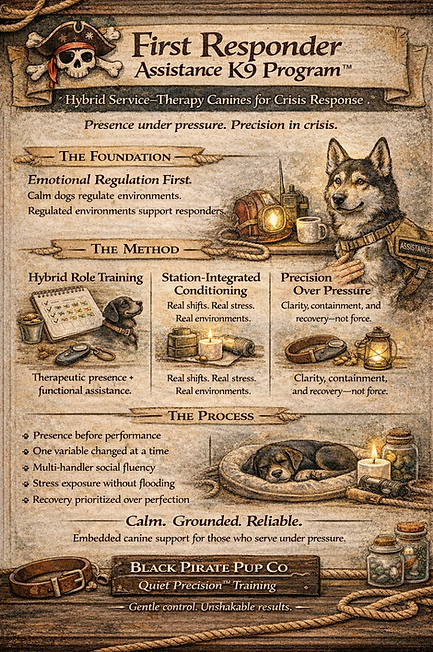
Method Overview: Presence + Precision + Purpose
1. Emotional Regulation and Stress Neutrality First
Before any task work, the canine must demonstrate:
-
calm engagement with responders
-
emotional neutrality in high-arousal settings
-
stability during group and individual interactions
This lays the groundwork for effective presence — because without internal regulation, a canine cannot reliably support another nervous system.
2. Dual-Role Shaping: Therapy + Functional Support
Our dogs are shaped to operate at multiple levels:
Therapy role (AAI):
-
gentle physical support during debriefs
-
passive presence during downtime
-
comforting engagement during emotional processing
Assistance role (AACR):
-
task training specific to stress response
-
interrupting hyperarousal
-
re-orientation cues after difficult calls
-
predictable, reliable responses in varied environments
Skill sets blend nurturing behavior with function, so the canine is both grounding and operational.
3. Contextual Conditioning
Canines live onsite 24/7 not as “visitors,” but as members of the station family.
They learn:
-
station routines
-
shift patterns
-
spatial flow and environmental cues
-
social dynamics among crews
This lived exposure adapts their training to real-life patterns, not controlled classroom drills.
4. Handler & Team Protocol Integration
We train not only the canine — but also:
-
department leadership
-
peer responders
-
shift teams
-
support staff
Together we establish:
-
communication protocols
-
canine access rules
-
interaction expectations
-
safety and welfare standards
This ensures both canine well-being and maximal utility for the human team.
5. Generalization Across Stress Sources
Support must hold whether:
-
after a major fire
-
following a fatal rescue
-
during a long shift
-
in everyday station life
We generalize the dog’s responses by incrementally increasing:
-
environmental complexity
-
emotional stimuli
-
group size
-
unpredictability
This means the canine can be present, calm, and available across the full spectrum of first responder needs.
Program Outcome
Canines trained through the First Responder Assistance K9 Program are:
✔ Emotionally neutral and regulation-oriented
✔ Socially fluent within team environments
✔ Capable of therapeutic presence and stress mitigation
✔ Reliable in function and consistent in comfort✔ Protocol-trained and team-integrated
✔ Ready for real world crisis response and daily station life
They are not simply therapy dogs.
They are not just service dogs.
They are responsive companions who create calm, promote resilience, and embed into the culture of service teams — reducing the emotional burden of crisis work by being present, predictable, and purposeful.
ON DUTY ASSISTANCE K9's WE HAVE TRAINED AND PLACED
As a new program, we have currently trained and placed K9 Chief Scruff that lives full time at Riviera Beach Fire Station 88 and we are in the works of negotiations with other departments in Palm Beach County, Florida

Chief Scruff
performing Deep Pressure Therapy in the common room at Station 88 in Riviera Beach

Chief Scruff
showing off his working vest

Chief Scruff
comforting a fire fighter at station 88 after a difficult call

Chief Scruff
earning his AKC Canine Good Citizen and Urban Canine Good Citizen titles

Chief Scruff
helping teach fire safety to children in the local community

Chief Scruff
on staff with the whole B shift during Hurricane Milton
THE SCIENCE BEHIND ASSISTANCE K9'S
The UCLA Health research on Animal Assisted Intervention substantiated that assistance dogs provide tremendous benefits for both mental and physical health.
Their study found that these trained animals have the following benefits for mental health:
• The simple act of petting animals releases an automatic relaxation response. This includes the release of serotonin, prolactin and oxytocin to help elevate overall mood
• Lowers anxiety, provides comfort and reduces loneliness
• Increases mental stimulation and assists in the recall of memories and help sequence temporal events
• Can provide an escape or happy distraction
• Even assist as a catalyst in the therapy process and may reduce initial resistance that might accompany further therapy
As for physical health, the benefits include:
• The lowering of blood pressure and improves cardiovascular health
• Reduces the number of medications a first responder may need to take
• Breathing physically slows in those that are overly anxious
• Releases hormones such as Phenylethylamine, which has the same effect as chocolate
• Diminishes overall physical pain
• Motivates an individual to seek further professional therapy if needed
• Create a deep bond with the animal and may feel that they are able to relate better than a human